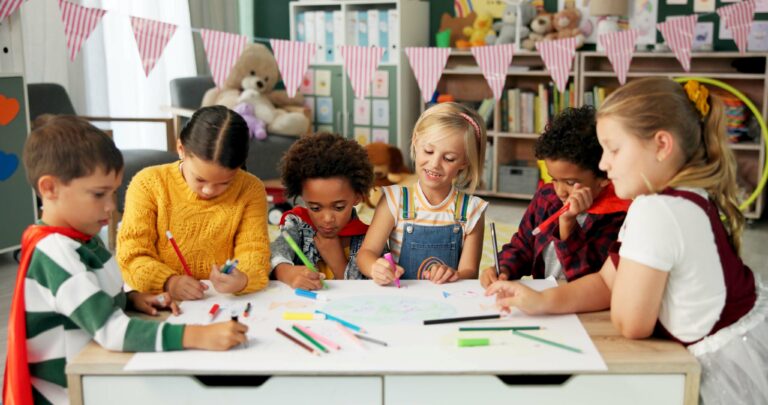
Bringing art into the classroom gives your students a new way to get involved. They open up more, stay focused longer, and feel like their voice matters, even if they’re not the loudest one in the room. Creative projects let them take the lead, get hands-on, and connect to what they’re learning in a way that feels real.
You don’t need to be an art teacher to bring art into your classroom. What you do need is a mindset that values creativity as part of the learning process. When students are actively making, building, or designing, they’re involved, engaged, and thinking critically.
Here are a handful of creative art projects for students that have sparked real engagement—and that you can easily adapt to fit your space, your time, and your students.
Art Projects for Kids in Your Classroom
Visual Journals
A visual journal is a safe space for students to jot down their thoughts and expressions. It’s a place for students to reflect, experiment, and be creative.
Each student gets a notebook or sketchbook, and inside goes a mix of drawings, paintings, clippings, scribbled thoughts, poetry, song lyrics, or anything that helps them process what they’re learning or feeling.
You can give students a prompt like “a memory I carry with me,” or even tie it into other subjects like sketching a science concept or illustrating a scene from a book.
Over time, these journals turn into something personal. There’s no pressure to make it perfect, and they’re not meant to be put on display. These are easy art projects for kids because they’re just for them, and having that kind of privacy can make a big difference.
Collaborative Mural
There’s something really special about students working together on a large-scale art piece like a mural. Murals give everyone a role, whether it’s outlining, painting, designing, or coming up with the theme. You can use butcher paper, a large bulletin board, or even repurpose cardboard boxes and turn them into movable walls of art.
Themes can be tied to class goals, like “What Community Means to Us” or “Our Hopes for the Future.” The final result doesn’t have to be perfect; what matters most is that students built it together and that they can see their contribution every time they walk by.
Art from Upcycled Materials
When students realize they can make something beautiful out of nothing, it can shift their whole perspective. Gather cardboard scraps, bottle caps, newspaper, string, bits of fabric, or anything clean and safe that would otherwise be tossed out.
Put it all on a table and challenge your students to create something meaningful out of it. You (and the students) will be surprised at what they come up with. This kind of hands-on activity pushes problem-solving and innovation without needing a trip to the art supply store.
Identity Collages
For some students, it’s hard to put their experiences into words. Creating an identity collage helps students to tell their stories without having to use words. Students can reflect on who they are, where they come from, and what they care about, all without saying a single word.
To have students create one, provide magazines, newspapers, colored paper, stickers, markers, or whatever you have, and let them build a piece that reflects their story. It could be literal or abstract. You can have them present it to the class or keep it private. Whatever way you choose, it gives them a voice.
Blending Art into Academics
Art doesn’t have to be separate from core subjects, it can be blended into any subject or lesson to make it more dynamic. Consider having students illustrate a scene from a novel using only shapes and colors to represent mood.
Or for history, let them build a timeline in the form of a comic strip. In science, they can create a diagram of a plant cell using textured materials, or make a flipbook that shows the water cycle in motion. These are just a few examples, the options are endless.
You can also use artistic reflection after assessments as a part of art projects for students. Have students create a visual piece that represents what they learned, what challenged them, or what they’d like to explore next. It’s a creative and meaningful way to wrap up a unit, and not to mention, it gives you insight into their thinking that a test never could.
Artistic Interpretation
Play a piece of instrumental music or read a poem aloud, then have students respond using color, movement, or form. They can turn the feeling of a poem into a painting or show the flow of the music through shapes and lines. This really works with students who think in pictures or have a harder time connecting with more traditional assignments.
The goal isn’t for students to land on one “right answer.” It’s about how different interpretations come to life, and how much can be expressed without using words. This kind of activity also works great for gallery walks, where students can see how each person’s mind and creativity work in their own unique way.
Pop-Up Galleries and Art Shows
Pop-up galleries and classroom art shows are a simple way to make student work feel important. Consider setting up a hallway display, turning a bulletin board into a mini gallery, or putting together a quick digital slideshow to share with families.
You can even invite other classes to stop by or have students record short clips explaining what they made and why they made it. Even the students who usually aren’t overly vocal about their work feel proud when their work is up for others to see. It shows them that what they created matters—and that’s a feeling they won’t forget.
Art Activism
Older pupils really get into art projects for students that mean something to them. Give them the chance to create visual pieces around causes they care about—things like climate change, equality, mental health, or issues in their own communities. They can make posters, zines, comics, or even short videos using free tools.
When there’s a real purpose behind the work, student motivation goes up. It stops feeling like just another assignment and starts feeling like a way to speak up and be heard. That kind of creative expression can be quite powerful for students.
Art project for students don’t need to be complicated or expensive. It just needs to be intentional. When you give students the tools and space to create, you’re not just building engagement—you’re building connection, confidence, and enjoyment.
Educators never stop learning; check out our available graduate degree programs to hone your skills and promote lifelong learning and academic excellence.